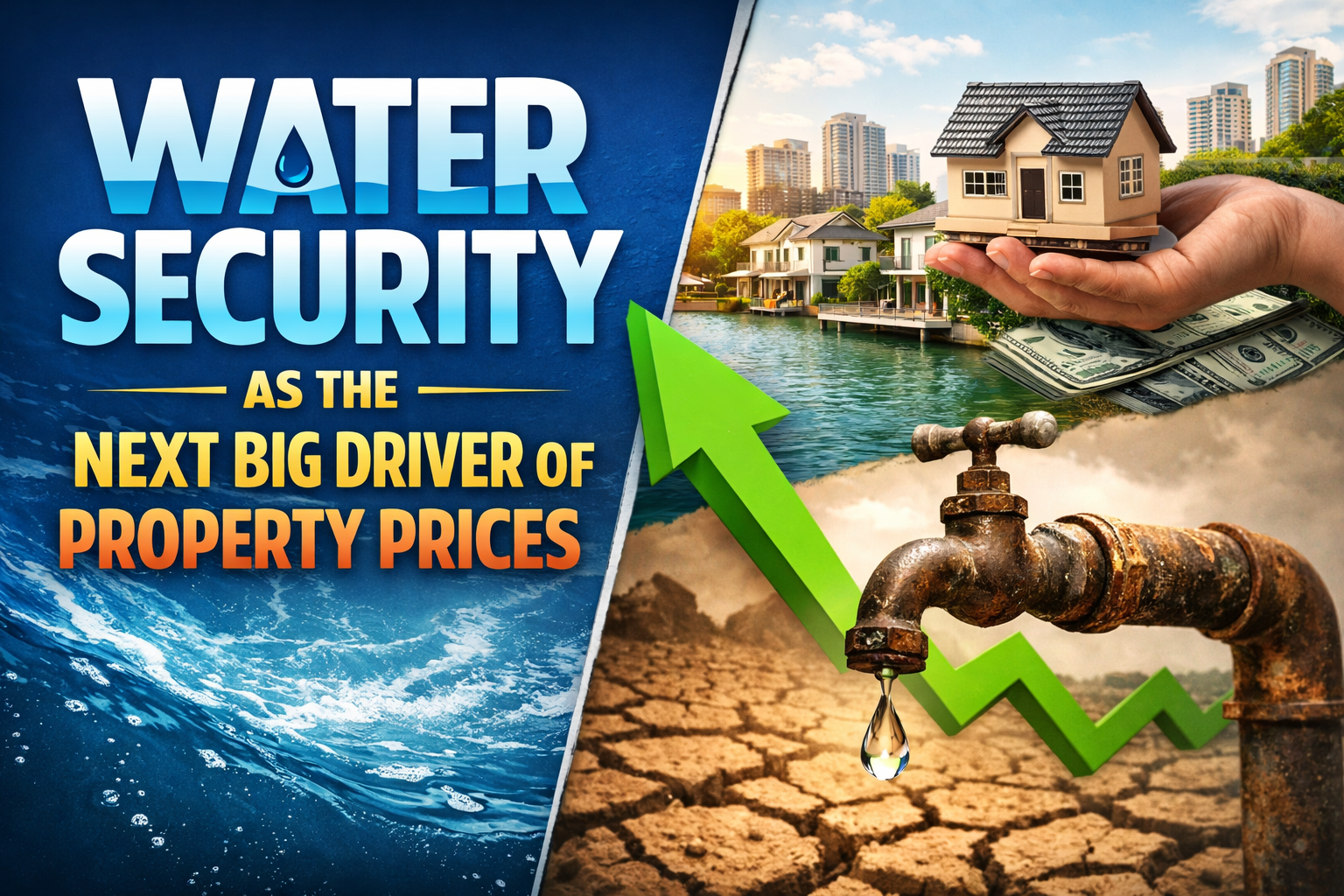
Water Security as the Next Big Driver of Property Prices
Water security real estate is becoming a major factor in property valuation as cities with reliable water resources attract long-term investors and residents.
Table of Contents
Introduction
Water security real estate is rapidly emerging as a defining factor in long-term property valuation. While traditional real estate drivers such as location, infrastructure, and economic growth remain important, access to reliable water resources is becoming a critical consideration for investors, developers, and governments worldwide.
As climate pressures, urbanization, and population growth strain water systems, cities with sustainable water management are gaining a strategic advantage—translating directly into rising property demand and price stability.
What Is Water Security and Why It Matters to Real Estate
Water security refers to the reliable availability of clean, accessible water to support households, industries, and infrastructure over the long term. For real estate markets, this means more than just supply—it involves resilience, planning, and sustainability.
Regions facing water shortages often encounter: Water Security as the Next Big Driver of Property Prices
- Development restrictions due to limited resources
- Higher infrastructure costs to transport or treat water
- Reduced investor confidence
- Increased living costs impacting affordability
- Long-term uncertainty about urban expansion
These risks are making water security real estate an increasingly important lens for evaluating property investments.
Cities With Strong Water Infrastructure Are Gaining Value
Urban centers that proactively invest in water sustainability—such as reservoir systems, recycling technologies, and efficient distribution networks—are positioning themselves as safer long-term housing markets.
This is driving water security real estate demand in locations that offer: Water Security as the Next Big Driver of Property Prices
- Reliable freshwater sources
- Advanced water conservation policies
- Climate-resilient infrastructure
- Integrated urban planning aligned with sustainability goals
- Lower exposure to drought-related disruption
As a result, buyers are beginning to evaluate water stability alongside economic opportunity when choosing where to live.
Developers Are Rethinking Project Design Around Water Efficiency
Real estate developers are increasingly integrating water-conscious design into new projects. Buildings are no longer judged solely on aesthetics or density, but also on how efficiently they manage natural resources.
Modern features supporting water security real estate include: Water Security as the Next Big Driver of Property Prices
- Rainwater harvesting systems
- Greywater recycling for landscaping and utilities
- Smart irrigation technologies
- Water-efficient fixtures and appliances
- Sustainable landscaping designed for local climates
These innovations reduce long-term operational risks while appealing to environmentally aware buyers.
Water Risk Is Quietly Affecting Property Insurance and Financing
Financial institutions and insurers are beginning to factor water availability into their risk models. Properties in water-stressed regions may face: Water Security as the Next Big Driver of Property Prices
- Higher insurance premiums
- Stricter lending requirements
- Increased operational costs
- Reduced resale predictability
Conversely, developments located in water-secure environments often benefit from stronger financing confidence, reinforcing the growth of water security real estate as a stable asset category.
Industrial and Commercial Development Also Depends on Water Stability
Beyond residential markets, industries such as manufacturing, technology, and agriculture require dependable water access. Companies increasingly choose locations based on resource security, which in turn drives employment growth and housing demand.
This interdependence strengthens water security real estate by linking resource availability directly to economic expansion and urban development patterns.
Governments Are Prioritizing Water as Urban Infrastructure
Public policy is beginning to recognize water systems as essential infrastructure comparable to transportation or energy. Investments in desalination, recycling, and conservation are shaping where future growth can occur.
Cities that align real estate expansion with long-term water planning are more likely to attract both residents and institutional investors, reinforcing the importance of water security real estate in national development strategies.
Investors Are Adding Resource Analysis to Property Evaluation
Forward-looking investors are now incorporating environmental resource assessments into their due diligence. Evaluating a market’s water resilience helps determine whether property values are sustainable over decades rather than just market cycles.
Key evaluation factors include: Water Security as the Next Big Driver of Property Prices
- Local water supply diversity
- Infrastructure modernization plans
- Regulatory frameworks for conservation
- Population growth relative to resource capacity
- Climate adaptability measures
These considerations are redefining what constitutes a “prime location.”
Challenges in Balancing Growth and Sustainability
While water-secure regions benefit from increased demand, they must carefully manage growth to avoid overconsumption. Without responsible planning, rapid expansion could strain the very systems that attract investment.
This makes long-term governance and environmental stewardship central to sustaining water security real estate advantages.
Conclusion
Water availability is transitioning from a background utility to a central determinant of real estate value. As global awareness of resource sustainability grows, markets that can guarantee reliable water access will stand out as stable, future-ready investment destinations.
Water security real estate represents a shift toward resource-driven valuation—where environmental resilience becomes just as important as economic performance. For investors, developers, and policymakers, recognizing this connection is essential to navigating the next era of global property markets.