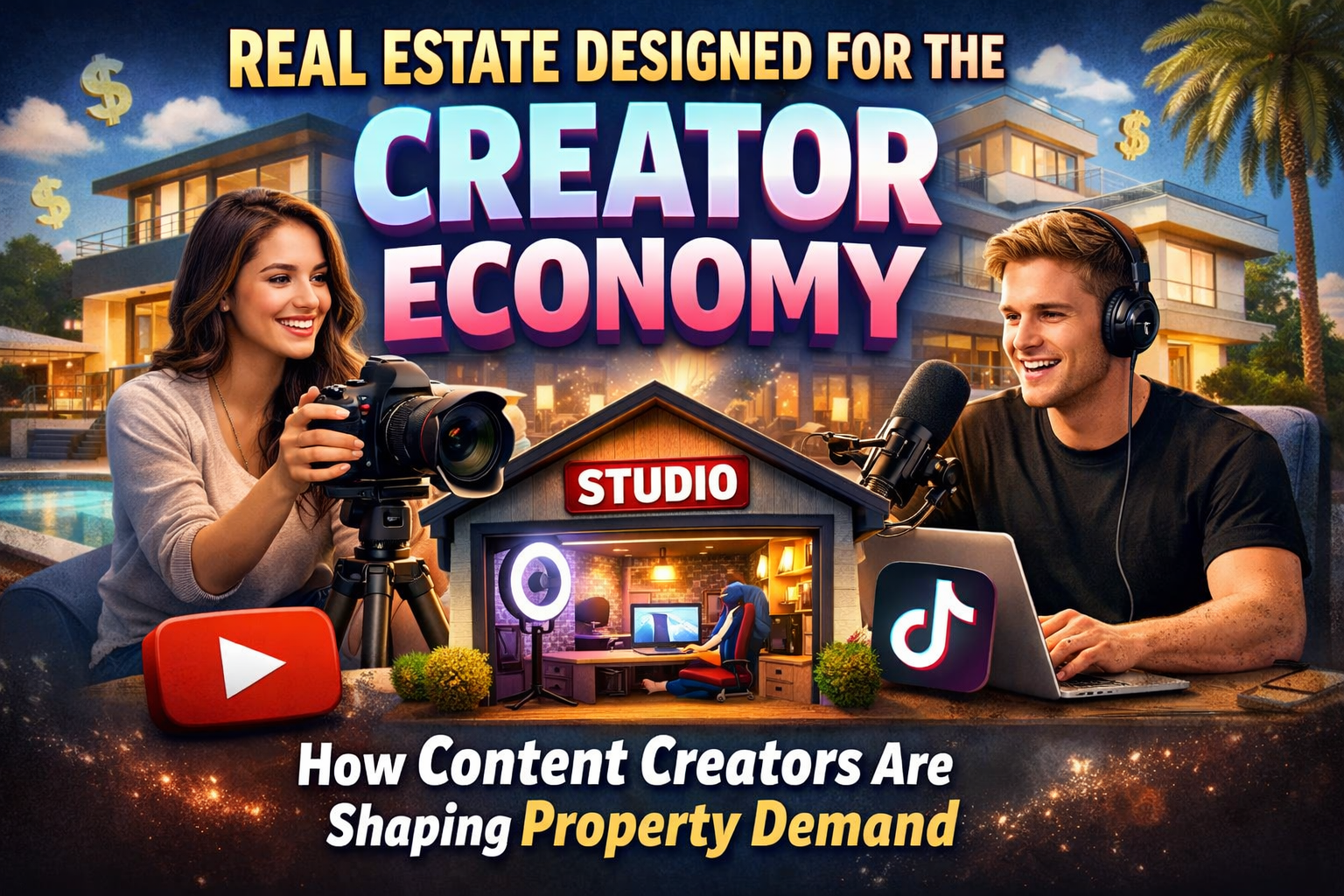
Real Estate Designed for the Creator Economy
Real Estate Designed for the Creator Economy: How Content Creators Are Shaping Property Demand :Creator economy real estate is transforming housing design as influencers, freelancers, and digital professionals demand homes built for content creation, live-work flexibility, and digital income.
Table of Contents
Introduction
Creator economy real estate is emerging as a new niche within global property markets, driven by the rapid growth of digital professionals who monetize content, creativity, and online influence. From video creators and podcasters to designers and independent educators, millions of individuals now earn income without traditional office spaces.
This transformation is creating demand for properties that function simultaneously as living environments, production studios, and business headquarters—reshaping how residential real estate is designed, marketed, and valued.
Understanding the Creator Economy’s Impact on Housing
The creator economy includes professionals who generate revenue through digital platforms, remote services, and intellectual property rather than location-based employment.
These individuals require spaces that support: Real Estate Designed for the Creator Economy: How Content Creators Are Shaping Property Demand 2026
- High-quality content production
- Flexible work schedules
- Integrated digital infrastructure
- Brand-building environments
- Multi-functional room usage
As a result, creator economy real estate is focused less on traditional residential layouts and more on adaptable, productivity-driven design.
Homes Are Becoming Production Spaces
Unlike conventional remote workers, creators often need built-in environments for filming, recording, editing, or live streaming. This has led developers to incorporate features such as: Real Estate Designed for the Creator Economy: How Content Creators Are Shaping Property Demand 2026
- Sound-treated rooms for audio and video recording
- Flexible studio-style layouts with adjustable lighting
- High-speed, enterprise-grade internet connectivity
- Dedicated creative work zones within residential units
- Background-friendly interior aesthetics suitable for on-camera use
These elements transform homes into operational creative studios, redefining residential functionality.
Live-Work Integration Is the Core Value Proposition
In creator economy real estate, the boundary between home and workplace disappears entirely. Properties are designed to accommodate both personal living and professional output without compromise.
This integration allows creators to: Real Estate Designed for the Creator Economy: How Content Creators Are Shaping Property Demand 2026
- Reduce reliance on rented studio space
- Maintain flexible production schedules
- Scale their work without relocating
- Operate global businesses from residential settings
Developments that enable seamless live-work transitions are increasingly attractive to this growing demographic.
Location Preferences Differ From Traditional Buyers
Creators often prioritize inspiration, affordability, and connectivity over proximity to financial districts. As a result, creator economy real estate demand is rising in locations that offer: Real Estate Designed for the Creator Economy: How Content Creators Are Shaping Property Demand 2026
- Lifestyle-driven environments such as cultural districts or scenic settings
- Lower cost of living combined with strong digital infrastructure
- Access to collaborative creative communities
- Flexible zoning allowing mixed residential-commercial use
This is redistributing housing demand beyond conventional urban centers.
Co-Creation Spaces Are Emerging as Hybrid Developments
Developers are beginning to design communities specifically for digital professionals, blending residential units with shared production amenities.
Such projects may include: Real Estate Designed for the Creator Economy: How Content Creators Are Shaping Property Demand 2026
- Shared podcast or video studios
- Collaborative editing and meeting spaces
- Event venues for workshops or launches
- Community-driven networking environments
- Technology-enabled common areas for digital collaboration
These ecosystems enhance productivity while fostering peer engagement, a key factor in creator success.
Investment Potential in Creator Economy Real Estate
For investors, this segment offers exposure to a rapidly expanding workforce that values flexibility and functionality over traditional ownership patterns.
Benefits include: Real Estate Designed for the Creator Economy: How Content Creators Are Shaping Property Demand 2026
- Demand from a global, location-independent tenant base
- Premium pricing for turnkey creative-ready spaces
- Reduced reliance on corporate leasing cycles
- Adaptability across residential and mixed-use classifications
- Long-term relevance tied to digital economic expansion
As digital entrepreneurship grows, so does the stability of demand supporting creator economy real estate.
Technology Infrastructure Is the New Amenity
In creator-focused housing, digital capability is as essential as utilities. Properties increasingly compete based on technological readiness, offering: Real Estate Designed for the Creator Economy: How Content Creators Are Shaping Property Demand 2026
- Redundant high-speed connectivity
- Acoustic optimization for recording
- Smart lighting and automation systems
- Integrated editing and workstation layouts
- Cloud-based building services supporting remote management
This emphasis reflects the shift from consumption-oriented housing to productivity-enabled environments.
Challenges in Designing for the Creator Economy
Despite its potential, creator economy real estate must address unique considerations:
- Balancing residential comfort with professional functionality
- Managing noise and production activity within shared environments
- Navigating zoning regulations not built for hybrid usage
- Designing adaptable spaces for rapidly changing technology needs
- Avoiding over-specialization that limits resale flexibility
Developers who design modular, future-proof environments are better positioned to sustain value.
Long-Term Outlook
As independent digital work continues to expand, housing will increasingly reflect the needs of individuals who operate businesses from wherever they choose to live. This evolution signals a move toward experience-driven residential models that prioritize adaptability, connectivity, and creative productivity.
Creator economy real estate is likely to remain a growing category as digital platforms continue to decentralize how and where people work.
Conclusion
The rise of the creator economy is not only changing employment structures—it is reshaping the physical spaces where people live and produce value. Real estate designed for creators blends residential comfort with professional capability, forming a new hybrid model aligned with digital entrepreneurship.
As this workforce expands globally, creator economy real estate stands poised to become a defining feature of modern housing, reflecting a world where creativity, technology, and lifestyle converge within the same space.