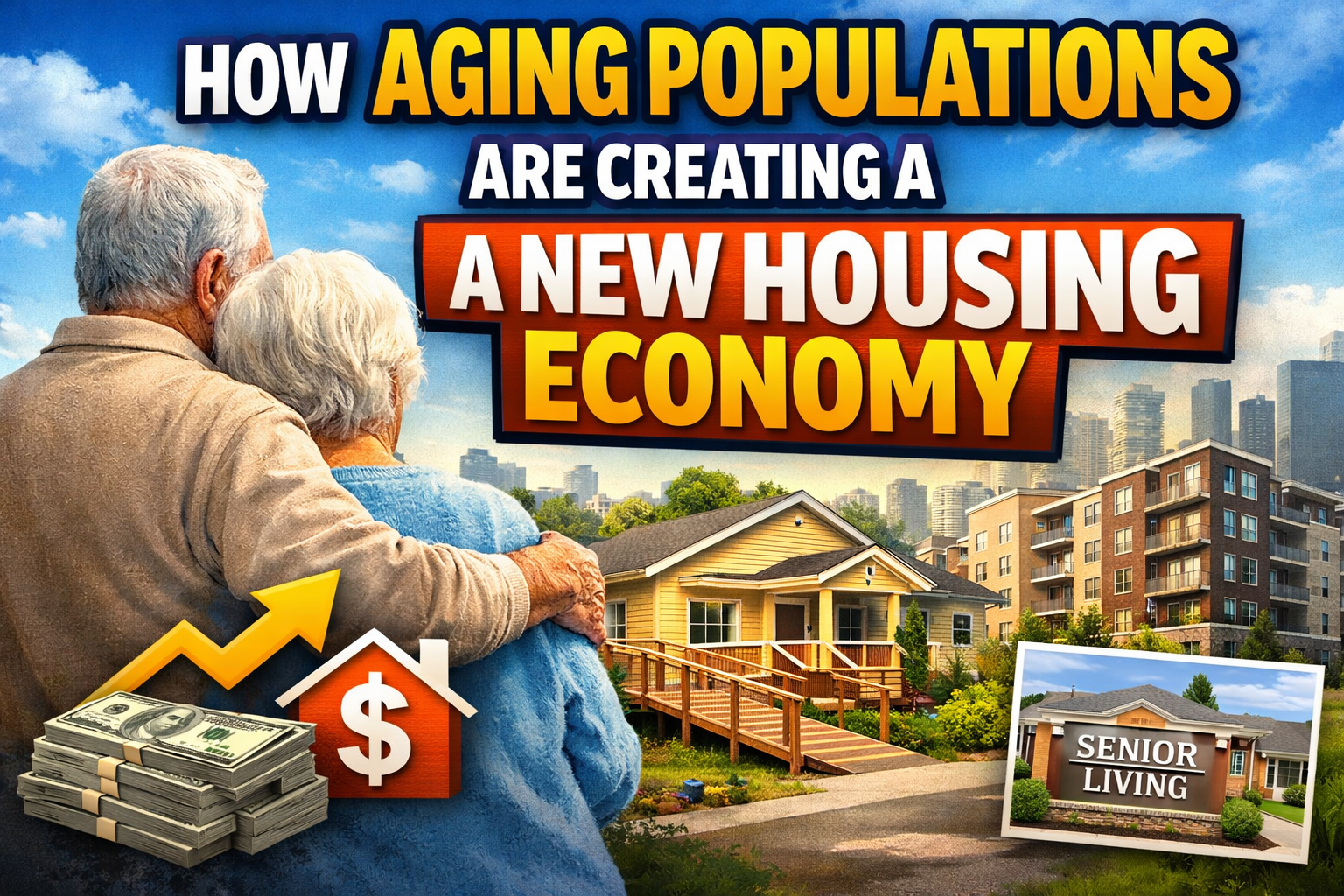
How Aging Populations Are Creating a New Housing Economy
Discover how aging populations are reshaping global housing demand, driving growth in senior living, healthcare-integrated homes, and age-friendly real estate investment opportunities.
Table of Contents
Introduction
One of the most powerful yet under-discussed forces transforming global real estate is demographic change. Across many countries, populations are aging rapidly due to longer life expectancy, declining birth rates, and improved healthcare systems. This demographic shift is not only affecting labor markets and healthcare systems—it is fundamentally reshaping housing demand, development strategies, and investment models.
As millions of people enter retirement age each year, the world is witnessing the rise of a new housing economy centered on longevity, accessibility, and lifestyle-driven living rather than traditional family housing patterns.
The Demographic Shift Driving Real Estate Change
In many developed and emerging economies, the proportion of residents aged 60 and above is growing faster than any other demographic group. This creates new housing requirements that differ significantly from those of younger populations.
Older adults increasingly seek homes that offer:
- Accessibility and mobility-friendly design
- Proximity to healthcare and essential services
- Reduced maintenance responsibilities
- Community engagement and social connection
- Long-term comfort rather than expansion space
These needs are giving rise to housing categories specifically tailored to aging residents.
The Expansion of Senior Living as a Core Real Estate Segment
Senior living is evolving beyond traditional retirement homes into a diverse spectrum of residential options, including: How Aging Populations Are Creating a New Housing Economy
- Independent living communities
- Assisted living environments
- Active adult housing developments
- Age-integrated mixed-use neighborhoods
- Healthcare-linked residential complexes
These models prioritize independence while embedding support systems, making them attractive not only to residents but also to investors seeking stable, needs-based demand.
Longevity Is Redefining What “Home” Means
People are living longer, healthier lives, often remaining active well into their seventies and eighties. As a result, housing is being designed to support multi-stage aging rather than a single life phase.
Developers are incorporating:
- Step-free layouts and universal design principles
- Smart-home technology for health monitoring and safety
- Walkable environments reducing reliance on vehicles
- Flexible interiors adaptable to changing mobility needs
- Integrated wellness amenities such as fitness, therapy, and recreation spaces
Homes are no longer static structures—they are becoming long-term lifestyle platforms.
Healthcare and Housing Are Converging
The intersection between residential real estate and healthcare services is one of the defining characteristics of this new housing economy. Many developments now include: How Aging Populations Are Creating a New Housing Economy
- On-site medical services or partnerships with healthcare providers
- Preventive wellness programs embedded into community design
- Emergency response technologies and telemedicine access
- Proximity to hospitals and specialized care centers
This integration reduces strain on public healthcare systems while enhancing the value proposition of age-focused housing developments.
Why Investors Are Paying Close Attention
Aging populations create demand that is less cyclical than traditional housing markets. Unlike discretionary purchases, age-related housing needs are often necessity-driven, offering: How Aging Populations Are Creating a New Housing Economy
- Stable occupancy rates
- Long-term tenancy patterns
- Predictable revenue streams
- Reduced sensitivity to economic volatility
- Growing demand across multiple regions simultaneously
For institutional investors, this segment represents a demographic-backed asset class rather than a trend-dependent one.
Urban Planning Is Adapting to an Older Population
Cities are beginning to redesign infrastructure to support age-friendly living. This includes: How Aging Populations Are Creating a New Housing Economy
- Expanded pedestrian pathways and accessible transport systems
- Public spaces designed for safety and social interaction
- Localized services reducing travel distances
- Housing integrated within community ecosystems rather than isolated facilities
These changes are influencing where new developments are approved and how property values evolve in accessible neighborhoods.
The Rise of “Aging in Place” Housing Models
Not all older adults want to relocate to dedicated retirement communities. Many prefer to remain in familiar environments while upgrading to homes designed for long-term usability.
This has sparked demand for:
- Retrofitted residential properties with accessibility upgrades
- Smaller, manageable homes within established neighborhoods
- Multi-generational housing layouts
- Smart-home systems that enable independent living longer
This segment is expanding renovation-driven real estate activity alongside new construction.
Challenges Developers Must Address
Despite its growth potential, age-focused housing requires thoughtful planning to avoid becoming institutional or isolating. Key challenges include: How Aging Populations Are Creating a New Housing Economy
- Balancing healthcare integration with residential comfort
- Ensuring affordability across income levels
- Designing communities that remain socially connected
- Navigating regulatory frameworks tied to both housing and healthcare
- Adapting developments to cultural expectations in different countries
Success depends on creating environments that support dignity, autonomy, and engagement rather than simply providing accommodation.
Long-Term Implications for the Global Property Market
As aging populations expand, the real estate industry is gradually shifting from growth-driven development to sustainability-driven habitation. Demand is moving toward housing that supports long-term living, health resilience, and community-based design.
This evolution suggests that future property markets will be defined not only by economic expansion but by demographic necessity, with longevity becoming a central factor in housing strategy.
Conclusion
The aging of the global population is quietly but decisively creating a new housing economy—one rooted in accessibility, healthcare integration, and lifestyle sustainability. What was once considered a niche segment is now emerging as a major pillar of real estate demand.
For developers, investors, and policymakers, understanding these demographic-driven changes is essential. Housing is no longer just about shelter or investment; it is increasingly about enabling longer, healthier, and more connected lives in an aging world.