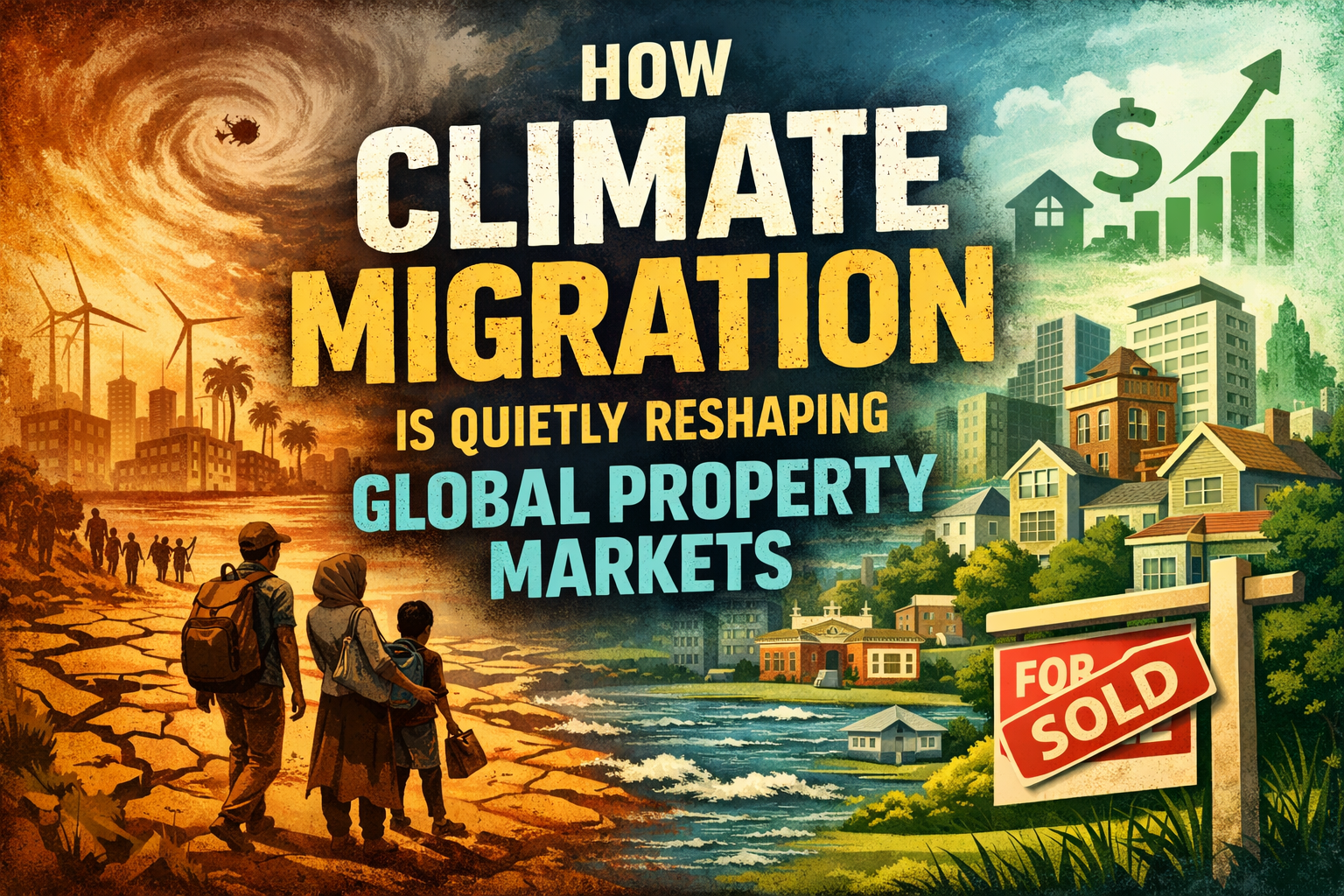
Discover how climate migration is transforming global property markets, influencing home values, investment hotspots, and long-term real estate strategies worldwide. Reshaping Global Property Markets
Table of Contents
Introduction
A new force is reshaping global real estate—one that is less visible than interest rates or economic cycles but far more structural in nature. Climate migration, the movement of people driven by environmental changes such as rising temperatures, flooding, droughts, and extreme weather events, is steadily altering where people live, invest, and build.
Unlike traditional migration driven by jobs or affordability, climate migration is rooted in long-term habitability. As certain regions face increasing environmental risk, populations are relocating to areas perceived as safer, more resilient, and better equipped for the future. This shift is already influencing housing demand, property valuations, infrastructure planning, and investor strategy across continents.
What Is Climate Migration?
Climate migration refers to the relocation of individuals or communities due to environmental stressors such as:
- Rising sea levels threatening coastal housing
- Water scarcity impacting agricultural regions
- Extreme heat reducing livability in dense urban areas
- Frequent wildfires, storms, or flooding increasing risk exposure
- Declining environmental insurance availability
These pressures are not hypothetical—they are influencing real-world decisions about where to buy, sell, or avoid property altogether.
Emerging “Climate-Safe” Property Hotspots
Certain regions are seeing increased demand because they offer relative environmental stability. These areas often feature:
- Reliable freshwater access
- Lower exposure to extreme weather events
- Moderate year-round temperatures
- Strong infrastructure resilience
- Government-led sustainability planning
Secondary cities in temperate zones are becoming particularly attractive, as buyers prioritize long-term security over traditional prestige markets.
This has led to what analysts describe as “resilience-driven appreciation”—property values rising not because of luxury demand, but because of perceived environmental durability.
Declining Demand in High-Risk Locations
Conversely, climate-vulnerable areas are beginning to experience market friction. In some regions:
- Insurance premiums have surged or become unavailable
- Financing has tightened for high-risk properties
- Buyers demand significant discounts
- Development approvals face new regulatory scrutiny
These factors are creating a gradual repricing of risk within real estate markets. Coastal luxury properties, for example, may retain short-term appeal but face long-term valuation uncertainty.
Infrastructure Is Becoming the New Location Advantage
Historically, the phrase “location, location, location” referred to proximity to jobs, schools, or lifestyle amenities. Climate migration is expanding that definition to include:
- Flood defense systems
- Energy grid reliability
- Sustainable water management
- Urban cooling designs
- Disaster-resistant construction
Cities investing heavily in climate adaptation are positioning themselves as future real estate anchors, attracting both residents and institutional capital.
Investor Strategies Are Quietly Evolving
Institutional investors, developers, and long-term property funds are increasingly incorporating climate analytics into acquisition decisions. New evaluation metrics include:
- Climate risk modeling over 30–50 year timelines
- Environmental insurance forecasts
- Local climate policy and mitigation investment
- Infrastructure resilience scoring
- Migration trend data
This marks a shift from short-cycle speculation toward durability-focused investing.
The Rise of “Resilient Design” in Housing Development
Developers are responding by rethinking how properties are designed. Modern projects increasingly include:
- Elevated construction in flood-prone areas
- Passive cooling architecture to reduce heat stress
- Water recycling and storage systems
- Fire-resistant materials in vulnerable landscapes
- Energy-independent buildings using renewable sources
Resilience is becoming not just a sustainability feature—but a selling point that influences buyer confidence.
Socioeconomic Implications for Global Cities
Climate migration also has complex social and economic effects:
- Rapid population growth in safer cities can strain affordability
- Previously overlooked regions may experience unexpected real estate booms
- Governments must balance growth with infrastructure expansion
- Urban planning is shifting toward long-term livability rather than short-term density
This redistribution of population is subtle but persistent, making it one of the most important demographic shifts influencing real estate in the 21st century.
What This Means for Buyers and Investors
For property buyers and investors, climate migration introduces a new strategic lens:
- Evaluate not just current value, but future environmental stability
- Research infrastructure investment plans in target cities
- Consider insurance trends as early warning indicators
- Favor regions actively planning for climate adaptation
- Think in decades, not market cycles
Real estate is increasingly tied to environmental resilience as much as economic growth.
Conclusion
Climate migration is not a sudden disruption—it is a gradual rebalancing of where people can sustainably live and invest. While the movement is still unfolding, its influence is already visible in shifting demand patterns, pricing structures, and development strategies worldwide.
As environmental realities continue to shape human settlement, the global property market is entering an era where resilience, adaptability, and long-term habitability will define value more than ever before.
Understanding this quiet transformation today allows investors, developers, and homeowners to make smarter, future-ready real estate decisions.