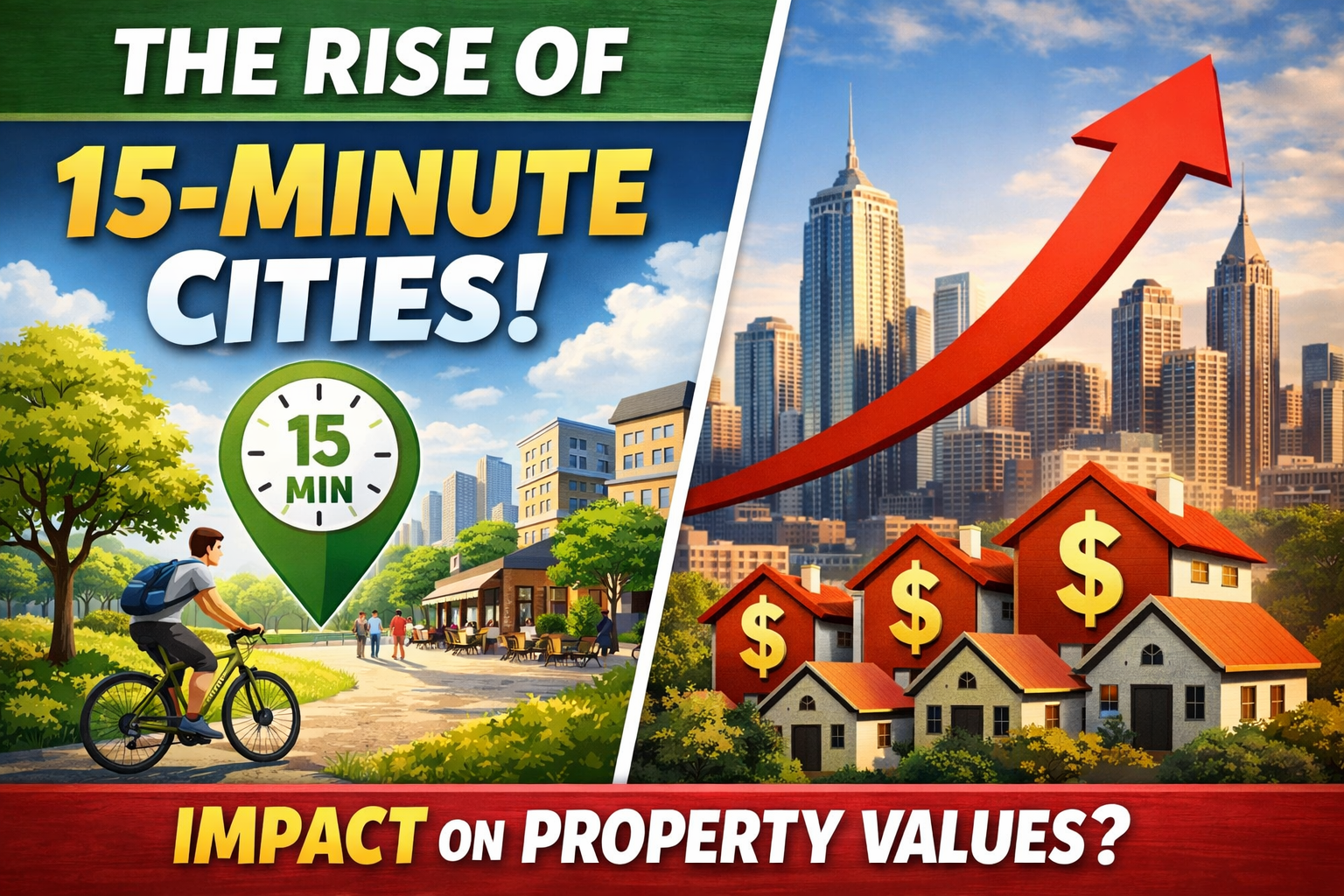
The Rise of 15-Minute Cities and What It Means for Property Values
Explore how the 15-minute city model is transforming urban living and driving new property value trends, investment opportunities, and demand for walkable neighborhoods worldwide.
Table of Contents
Introduction Of The Rise of 15-Minute Cities and What It Means for Property Values
Urban planning is undergoing a fundamental shift. Around the world, cities are adopting the “15-minute city” model—an approach designed to ensure that residents can access work, shopping, education, healthcare, and leisure within a 15-minute walk or bike ride from home.
Originally proposed as a sustainability and livability solution, this concept is now influencing real estate markets in profound ways. Property demand, valuation patterns, and development strategies are being reshaped as proximity replaces distance as the defining metric of desirability.
What Is a 15-Minute City?
A 15-minute city is an urban design framework where daily essentials are located within a compact, accessible radius. Instead of long commutes and car-dependent infrastructure, these cities emphasize:
- Mixed-use developments (residential + commercial integration)
- Walkability and cycling infrastructure
- Localized employment hubs
- Public transport connectivity
- Community-focused public spaces
This model is gaining traction in response to congestion, environmental concerns, and changing lifestyle expectations—especially after the global shift toward hybrid work.
Why Homebuyers Are Prioritizing Proximity
Modern buyers increasingly value time efficiency over square footage. Living closer to essential services reduces commute stress, transportation costs, and environmental impact: The Rise of 15-Minute Cities and What It Means for Property Values
As a result, neighborhoods that offer:
- Grocery stores, schools, and healthcare nearby
- Safe pedestrian infrastructure
- Cafés, parks, and co-working spaces
- Strong public transit integration
are seeing higher demand compared to traditional commuter suburbs.
This behavioral change is directly translating into measurable property value premiums.
Property Value Shifts: Walkability Is the New Luxury
Historically, luxury real estate was defined by size, exclusivity, or skyline views. Today, accessibility and convenience are becoming equally powerful drivers of price appreciation.
Research across multiple markets shows that walkable districts often command:
- Higher resale stability
- Faster transaction cycles
- Stronger rental demand
- Greater long-term appreciation potential
In essence, walkability is evolving into an economic asset class within real estate valuation.
Mixed-Use Developments Are Becoming Investment Hotspots
Developers are responding to 15-minute city demand by designing integrated environments where people can live, work, and socialize without leaving their neighborhood.
These projects typically include:
- Residential units above retail and offices
- Flexible workspaces for remote professionals
- Public plazas and green corridors
- Transit-oriented design
For investors, such developments reduce vacancy risk because they serve multiple needs simultaneously, creating self-sustaining micro-economies.
Reduced Car Dependency Is Changing Land Economics
As cities invest in pedestrian infrastructure and public transport, reliance on private vehicles declines. This has several real estate implications:The Rise of 15-Minute Cities and What It Means for Property Values
- Parking-heavy developments are losing appeal
- Land once allocated to roads is being repurposed for housing or public space
- Smaller, centrally located properties are outperforming large peripheral homes
- Transit-connected zones are gaining strategic importance
Urban land is being revalued based on accessibility rather than expandability.
Impact on Rental Markets and Younger Demographics
Younger professionals and digital workers are particularly drawn to 15-minute neighborhoods because they align with flexible lifestyles. Rental demand is increasing in areas that offer:The Rise of 15-Minute Cities and What It Means for Property Values
- Live-work-play environments
- Reduced commuting costs
- Social and cultural accessibility
- Sustainable living options
This trend is encouraging institutional investors to acquire properties in compact urban districts rather than distant suburban expansions.
Challenges Cities Must Navigate
Despite its advantages, the transition toward 15-minute cities comes with challenges:
- Risk of rising property prices leading to affordability concerns
- Infrastructure costs required to retrofit older urban layouts
- Balancing density with livability
- Preventing socioeconomic segregation between well-serviced and underserved zones
Urban planners must ensure inclusivity so the model benefits a wide population base rather than becoming an exclusive premium.
What This Means for Real Estate Investors
The rise of 15-minute cities signals a structural—not temporary—shift in how value is created in property markets. Investors should consider:The Rise of 15-Minute Cities and What It Means for Property Values
- Targeting walkable, transit-linked neighborhoods
- Monitoring municipal planning policies and zoning changes
- Prioritizing mixed-use assets over single-purpose developments
- Evaluating long-term livability metrics alongside financial returns
- Identifying emerging “micro-centers” within expanding cities
Future real estate winners are likely to be locations that minimize travel while maximizing access.
Conclusion
The 15-minute city is redefining urban desirability by placing human-scale living at the center of development. As convenience, sustainability, and time efficiency become critical lifestyle factors, property markets are recalibrating to reward accessibility over distance.
For buyers, developers, and investors, understanding this shift is essential. The cities that successfully implement this model are not just improving quality of life—they are creating the blueprint for the next generation of real estate value.
In the coming decade, proximity may prove to be the most powerful driver of property appreciation worldwide.